

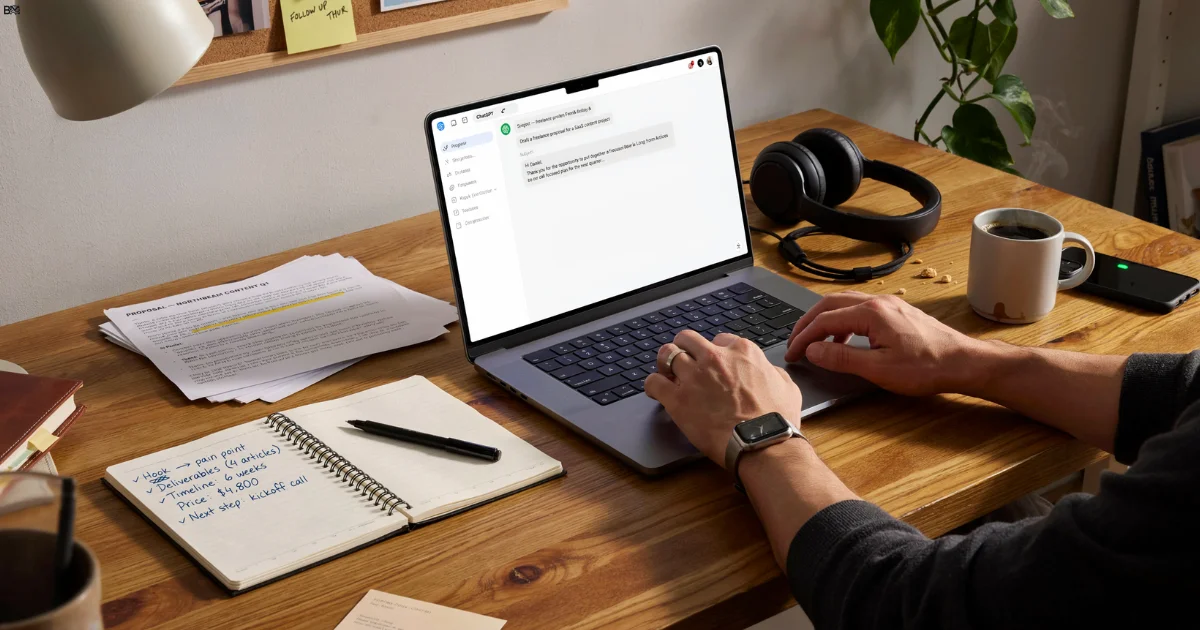
How to Use ChatGPT to Write Freelance Proposals That Win Clients
You know that bad feeling when your proposal gets no reply. You spend hours writing it, but clients just ignore it. Many freelancers lose good jobs this way. Freelance proposal writing feels hard and slow. But now you can make it simple and fun with ChatGPT. AI-powered proposals help you fix client pain points quickly. Success today isn’t just about effort; it is about using the best free AI tools in 2026 to stay ahead.
You learn easy proposal personalization to make every message special for the client. This way, you win high-paying clients without getting tired. This guide shows you simple steps like a friend teaching you. Your proposals will sound kind and clear. Clients will read them and say yes more often. Ready to try?
Why Most Freelance Proposals Fail (And How ChatGPT Fixes Them)

Most freelancers write proposals like resumes.
Clients are not hiring a resume.
They are buying relief.
Weak proposals focus on:
- Experience history
- Tool lists
- Certifications
- Portfolio links
Strong proposals focus on:
- The client’s financial risk
- Their urgency
- Their missed opportunity
- Their desired outcome
That difference changes everything.
When you master how to use ChatGPT to write freelance proposals, you shift the center of gravity. Instead of saying:
“I have 5 years of experience.”
You say:
“Here is how your cart abandonment problem gets reduced within 14 days.”
That psychological shift increases reply rates dramatically.
The 7 Deadly Mistakes That Kill Proposal Conversions
Here is what consistently destroys response rates:
| # | Mistake | What the Client Thinks |
| 1 | Generic intro | “This was copied.” |
| 2 | Talking about yourself first | “They didn’t read my post.” |
| 3 | No outcome clarity | “What exactly am I paying for?” |
| 4 | Weak structure | “This is hard to skim.” |
| 5 | No measurable proof | “Can they actually deliver?” |
| 6 | No pricing logic | “Why is this the price?” |
| 7 | No strong CTA | “What happens next?” |
If your proposal fails on even three of these, your freelance proposal writing chances drop fast.
ChatGPT helps fix structure instantly — but only if you guide it correctly.
How AI Changes the Game for Freelancers in 2026
The freelance market is crowded.
Speed now matters as much as skill.
Clients often hire the first freelancer who shows a clear understanding of their problem.
Freelancers who use structured AI workflows:
- Respond 3x faster
- Personalize every proposal
- Maintain energy without burnout
- Close higher-ticket contracts
AI does not win clients.
Strategic use of AI wins clients.
That distinction matters.
What Clients Actually Want in a Winning Freelance Proposal

Clients are not just evaluating skill.
They are evaluating risk.
Before hiring you, they subconsciously ask:
- Will this person disappear?
- Will they miss deadlines?
- Will I regret this decision?
- Will I look bad for choosing them?
Your proposal must dissolve those fears.
A strong value proposition answers one clear question:
“What changes for me if I hire you?”
When you understand how to use ChatGPT to write freelance proposals, you begin structuring proposals around transformation — not tasks.
The Psychology Behind Client Decisions
Clients buy emotionally first.
Then justify logically.
They need:
- Recognition of their frustration
- Clarity of solution
- Confidence in outcome
- A low-risk next step
If your proposal does not validate their problem in the first few lines, trust is never built.
The 5 Elements of Irresistible Proposals
| Element | Why It Works |
| Personalized Hook | Shows you actually read their post |
| Pain Recognition | Builds emotional alignment |
| Clear Solution Roadmap | Reduces uncertainty |
| Measurable Proof | Builds authority |
| Specific CTA | Creates momentum |
This is not a theory. This structure consistently outperforms long generic proposals.
Trust & Risk Reversal Signals
Trust accelerators include:
- Specific case metrics
- Mini case studies
- Industry familiarity
- Structured milestone plan
- Revision guarantees
Instead of saying “I’m reliable,” show reliability through process clarity.
How to Research Any Client Before Using ChatGPT
Skipping research is the fastest way to generate generic output.
AI only enhances what you feed it.
Before writing anything, gather:
- Client industry
- Competitor landscape
- Revenue model
- Hiring history
- Tone of communication
- Timeline pressure
Ten minutes of research doubles persuasion power.
How to Analyze Job Posts Strategically
Read the job post twice.
First pass: Identify deliverables.
Second pass: Identify emotional language.
Words like:
- “Urgent”
- “Frustrated”
- “Finally need help.”
- “Desperately looking”
These signals convey urgency and stress. That becomes your hook.
Questions to Answer Before Prompting AI
Before writing, answer:
- What problem is costing them money?
- What outcome would make them feel relieved?
- What proof can I provide that is relevant?
- What is their likely hesitation?
- What timeline pressure exists?
Feed those into ChatGPT.
NowAI becomes strategic.
Step 1: Feed ChatGPT the Right Client Information

Vague input produces weak output.
Detailed input produces persuasive output.
Here is a strong input structure:
text
Act as a senior freelance proposal strategist.
Client Industry: [Industry]
Core Problem: [Problem]
Financial Impact: [Impact]
Desired Outcome: [Outcome]
Timeline: [Timeline]
My Relevant Proof: [Case Result]
Tone: [Professional / Direct / Casual]
Write a 150-word personalized proposal.
Start with the client’s problem.
End with a clear CTA.
Specificity drives persuasion.
Extracting Hidden Pain Points
Example:
Client says: “Need website redesign.”
The underlying problem could be:
- Low conversions
- High bounce rate
- Poor mobile UX
- Brand credibility gap
Ask AI:
“What business risk is hidden inside this request?”
Then lead with that.
Step 2: Use ChatGPT for Deep Pain Analysis
Surface reading is average.
Deep analysis wins contracts.
Prompt:
text
Analyze this job post.
Identify:
1. Surface request
2. Financial risk
3. Emotional frustration
4. Ideal outcome
Now your proposal addresses:
- Revenue impact
- Competitive pressure
- Timeline urgency
- Reputation risk
That is strategic positioning.
Turning Features Into Outcomes
Instead of:
“I will optimize your SEO.”
Say:
“I will increase qualified traffic from high-intent search terms and reduce dependence on paid ads.”
Outcome framing increases perceived value.
Step 3: Build a High-Converting Solution Section
Your solution must answer:
- What will change?
- How will it change?
- How fast?
- Why you?
Use structured clarity.
Proposal Solution Blueprint
| Phase | Action | Result |
| Week 1 | Audit & Strategy | Identify profit leaks |
| Week 2 | Implementation | Fix conversion gaps |
| Week 3 | Optimization | Improve measurable metrics |
Clients love structure. Structure signals competence.
Integrating Your Unique Edge
Your USP might be:
- Industry specialization
- Faster turnaround
- Performance-based pricing
- Data-driven approach
Integrate naturally inside the solution language.
Never list randomly.

High-Converting ChatGPT Prompt Library
Upwork Prompt
text
Write a 120-word Upwork proposal.
Hook with client problem.
Include one measurable result.
Offer 3-step solution.
End with a friendly question.
Tone confident, human.
Cold Email Prompt
text
Write a 90-word cold outreach email.
Reference specific issue from website.
Offer one improvement.
End with simple question.
No hard sell.
Premium Project Prompt
text
Write a $5,000+ proposal.
Include personalized opening.
3-step roadmap.
One measurable case result.
ROI framing.
Clear next step.
Creating Reusable Proposal Templates
Instead of starting from scratch, build modular templates.
Core Proposal Framework
| Section | Word Range | Goal |
| Hook | 20–30 | Immediate relevance |
| Pain | 30–40 | Emotional validation |
| Solution | 60–80 | Process clarity |
| Proof | 20–30 | Credibility |
| CTA | 15–20 | Action trigger |
Use bracket placeholders for personalization.
Pricing Strategy That Converts
Clients reject unclear pricing.
They accept outcome-aligned pricing.
Pricing Model Comparison
| Model | Best Use | Risk | Income Potential |
| Hourly | Undefined scope | Medium | Limited |
| Fixed | Defined deliverables | Low | Stable |
| Value-Based | Revenue impact projects | Low | High |
Tiered Package Structure
| Tier | Includes | Ideal For |
| Basic | Core deliverables | Small projects |
| Standard | Core + optimization | Most clients |
| Premium | Full strategy + support | High-value clients |
Always connect pricing to impact.
Platform Optimization Strategy
Different platforms require tone adaptation.
Platform Comparison
| Platform | Ideal Length | Tone |
| Upwork | 100–150 words | Direct |
| Fiverr | 75–100 words | Friendly |
| Cold Email | 80–120 words | Curious |
The first two lines must mention the client’s problem.
Always.
Before vs After Example
Weak:
“I am a web designer with five years of experience.”
Strong:
“I noticed your store loads in 6 seconds — that delay is likely costing you conversions daily.”
Comparison
| Version | Focus | Response |
| Generic | Freelancer | Low |
| Strategic | Client problem | High |
Common Mistakes With AI
- Copy-pasting without editing
- Overly formal language
- Fake testimonials
- No tone adaptation
Best workflow:
- 70% AI draft
- 30% human refinement
Final Closing System
Before sending:
| Checklist |
| Client problem named |
| Outcome clear |
| Proof included |
| Deliverables structured |
| Clear CTA |
| Tone aligned |
| Under 200 words |
Follow-Up Strategy
Send follow-up after 48 hours.
Add one helpful insight.
Not pressure.
FAQs
How can I use ChatGPT to write freelance proposals that get answers?
First, explain the client’s problem in easy words. ChatGPT will help you turn that into a clear and short message people want to reply to.
Can ChatGPT really help me win freelance jobs?
Yes, it can guide your writing. It gives you strong ideas that make your proposal sound useful and smart.
Is it okay to use ChatGPT for writing proposals?
Yes, it is fine. Just make sure you add your own thoughts so it feels real and honest.
How can I make my proposal sound warm and friendly?
Ask for a simple and kind tone. After that, adjust it a little so it matches your own voice.
What is the easiest way to begin with ChatGPT for proposals?
Write the client’s problem, ask for a draft, and then edit it to make it personal.
External Resources
https://medium.com/@edithmwiti254/how-i-used-chatgpt-to-land-a-client-in-3-hours-fc828fdfafe1
“No experience? No problem. Your first freelance client is one click away.”