AI vs Human Thinking: Can AI Replace Humans in 2027?
The debate over AI vs Human Thinking in 2027 is no longer science fiction—it is a daily reality across American offices, cars, and smartphones. While many fear replacement, the truth is more practical. AI excels at pattern recognition and lightning-fast data processing, yet it stumbles where humans naturally lead. Your contextual understanding, ability to read a room, and sense of moral weight remain irreplaceable. Machines lack genuine emotional intelligence and struggle with the common sense reasoning that feels effortless to a child. That is why smart organizations focus on human-AI collaboration, not replacement. This guide walks you through what AI can and cannot do, and how to use both safely.
AI vs Human Thinking: Meaning, Definitions, and Scope
People argue about AI vs human intelligence because they use “thinking” in different ways. Some mean fast calculation. Others mean judgment under pressure. In this guide, AI vs Human Thinking means how systems choose actions using information. It also covers what society expects from those choices.
Replacement sounds absolute, but work rarely works that way. Most jobs contain many micro-tasks. AI can automate several of them. Yet humans still carry responsibility when things go wrong. That’s where human intelligence characteristics matter most, especially contextual understanding and consciousness and subjective experience.
How AI “Thinks”: Models, Data, Training, and Pattern Recognition
AI looks like a thinker, but it behaves more like a high-speed pattern machine. Modern tools rely on machine learning models that learn from examples. They ingest text, images, or clicks. Then they predict what comes next. That’s the core of AI pattern recognition and it powers chatbots, fraud flags, and recommendations.
This “thinking” depends on data quality and training choices. A system trained on messy records will act messy. It can excel at large-scale data processing, especially in natural language processing (NLP) tasks like summarizing. Still, the gap between AI decision-making vs humans often appears when the situation changes fast.
How Humans Think: Cognition, Emotions, Experience, and Embodiment
Humans don’t only compute. You interpret. You feel. You remember stakes. That’s why human cognition vs AI stays a real divide in 2027. Your brain links lived moments to meaning. It also uses your body as a sensor. You learn from tone, timing, and discomfort.
Emotions don’t “ruin” thinking all the time. They can signal values and danger. That’s why emotional intelligence vs AI matters in leadership, care, and negotiation. Humans also deliver empathy and human connection and they practice deep reflection and wisdom over time, not in milliseconds.
Key Differences Between AI and Human Thinking (Side by Side Comparison)
If you want clarity, compare capabilities in plain daylight. In AI vs Human Thinking, machines usually win on speed and scale. Humans often win on meaning and moral weight. This is the simplest way to think about AI speed vs human depth without hype.
| Dimension | AI (typical 2026–2027 tools) | Humans (typical real-world performance) |
| Speed | Very fast at routine analysis | Slower, but adaptable |
| Memory | Huge storage, quick recall | Forgetful, but meaning-based |
| Generalization | Often brittle outside training | Strong across messy contexts |
| Social reading | Weak on nuance | Strong with cues and intent |
| Responsibility | Cannot “own” outcomes | Can be accountable |
Even when AI answers correctly, it may not understand why. Humans can often explain tradeoffs. That difference matters in medicine, finance, and law. It also highlights common sense reasoning, which still trips many systems in surprising ways.
Narrow AI vs AGI: General Intelligence vs Human Like Intelligence
Most AI you use today is narrow. It does one thing well. That’s why narrow AI vs AGI defines the real 2027 landscape. A scheduling tool schedules. A writing tool drafts. A vision model spots patterns. None of that equals a general mind.
Researchers use the label Artificial General Intelligence (AGI) for systems that can pursue complex goals across many environments. Even if we move closer, “general” does not mean “human-like.” In practice, companies build human-aware AI systems that adapt to your limits, not systems that become you.
Moravec’s Paradox: Why Easy Human Skills Are Hard for AI

Here’s the twist most headlines miss. Tasks you find “easy” can be brutal for machines. Moravec’s paradox explains it. Chess feels hard but it’s structured. Folding laundry feels easy but it’s chaotic. The physical world hides endless edge cases.
That’s why artificial intelligence limitations show up fast in homes, hospitals, and construction sites. Yes, robotics and automation keep improving. Still, real rooms contain glare, clutter, pets, and slippery objects. Humans handle that with flexible perception and quick improvisation.
Creativity & Originality: AI Creativity vs Human Creativity
AI can remix styles at lightning speed. It can draft slogans, pitches, and story beats. Yet “creative” output often reflects what it has seen before. Humans create with intent. You create with taste. You also create with risk, because you care about outcomes.
This is where human intuition and creativity keeps an edge. A brand strategy, a film scene, or a courtroom argument depends on values and audience psychology. People also over-credit machines because of anthropomorphism in AI. We treat fluent text like a mind. It isn’t one.
Bias and Decision Making: Human Cognitive Biases vs Algorithmic Bias
Bias is not a one-team problem. Humans carry shortcuts. Machines absorb patterns from data. That’s why human cognitive biases and algorithmic bias in AI can both distort decisions. The difference lies in scale. A biased model can spread errors across millions of users quickly.
| Bias source | How it forms | Real risk | Practical check |
| Human bias | Habit and pressure | Unfair judgment | Structured review |
| Data bias | Skewed history | Discrimination | Dataset audits |
| Label bias | Wrong targets | Bad incentives | Redefine outcomes |
| Feedback loops | Model shapes reality | Runaway inequality | Monitor drift |
Researchers often cite cognitive biases (confirmation/availability) to explain human mistakes. AI shows different failure modes. It can inherit skewed labels. It can learn feedback loops. It can also reflect missing data. In the US, hiring filters, lending models, and policing tools deserve extra scrutiny.
Explainability, Trust, and Safety: When (Not) to Rely on AI
Trust should not feel like faith. It should feel earned. AI transparency and explainability helps, but it doesn’t solve everything. Some models behave like black boxes. In high-stakes work, teams should demand testing, monitoring, and clear escalation paths.
You can build safety with process, not vibes. Use verification and validation (V&V) to check performance against goals. Add human-in-the-loop oversight for decisions that affect rights, money, or health. Then practice trust calibration in AI so staff neither over-trust nor ignore useful signals.
AI vs Human Thinking: a simple “use or pause” rule
If an AI output could harm someone, pause and verify. If it affects legal status, pause and verify. If it changes medical care, pause and verify. When stakes rise, AI vs Human Thinking should default to human judgment plus documented checks.
“If you can’t defend the decision in public, don’t automate it.”
Human AI Collaboration: Augmented Intelligence Workflows That Work
The best teams don’t ask AI to replace people. They design roles. They decide who owns each step. This is human-AI collaboration at its best. AI drafts, sorts, and searches. Humans define goals, evaluate tradeoffs, and take responsibility.
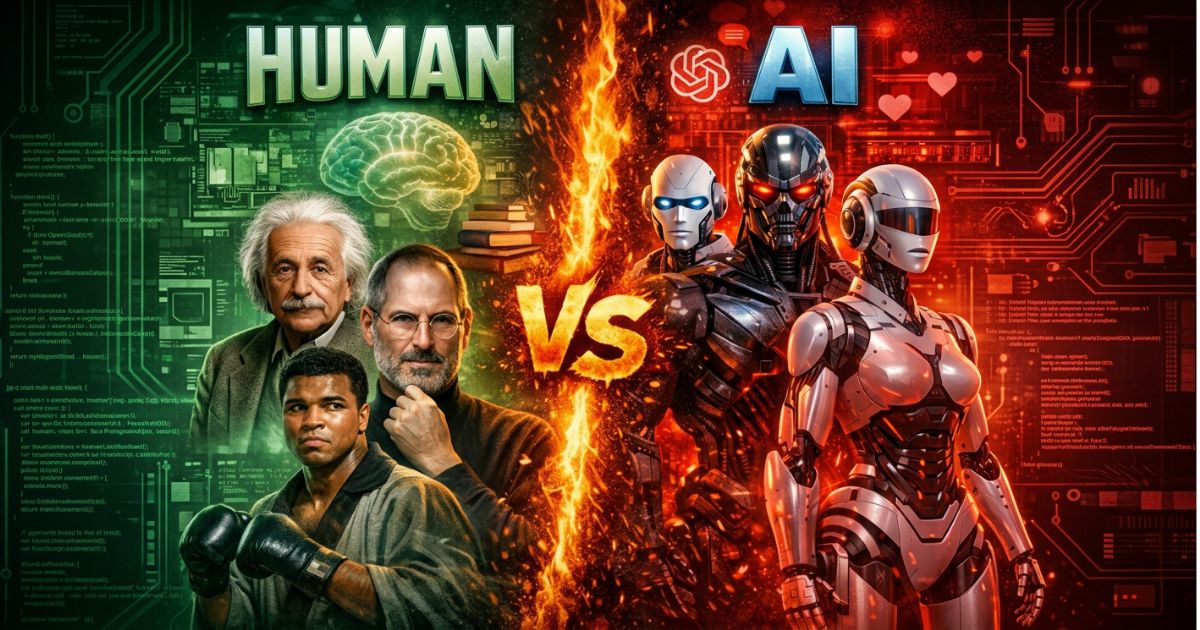
Many US workplaces already use augmented intelligence without calling it that. A nurse might use AI to triage images. A marketer might use AI to test copy. A security analyst might use AI to cluster alerts. Done well, AI vs Human Thinking becomes a relay race, not a boxing match.
Goal set by human → AI drafts options → Human checks facts → AI refines format → Human approves and signs
Future of Work: Job Disruption, New Roles, and Must Have Skills
The big story is task change, not total replacement. Still, future of work with AI will bring churn. Some roles will shrink. Some will shift. That’s the honest meaning behind AI job displacement. If your job involves repetitive text, routing, or reporting, expect heavy automation pressure.
At the same time, AI creates demand for new skills. US employers already hire for AI governance, data quality, and evaluation. The risk is uneven impact. The inequality and accessibility gap can widen if only some workers get training. For labor context, you can track occupational trends through the US Bureau of Labor Statistics at
| Work area | What AI replaces first | What humans still own in 2027 |
| Customer support | Triage and drafts | Escalations and empathy |
| Marketing | Variants and testing | Positioning and ethics |
| Healthcare admin | Coding suggestions | Patient context and consent |
| Software | Boilerplate code | Architecture and risk decisions |
Ethics, Privacy, and Governance: Building a Responsible Human AI Future

When AI touches people’s lives, ethics stops being abstract. It becomes operations. That’s where AI ethics and accountability needs real policies, not posters. The US faces sharp questions about surveillance, consent, and profiling. Those concerns sit under privacy and surveillance risks, especially with workplace monitoring and data brokers.
Governance also needs shared standards. Global guidance exists, including the UNESCO AI principles / governance standards and the NIST AI Risk Management Framework . In practice, responsible AI integration means clear data rules, audit trails, and human sign-off for high-stakes use. In that world, AI vs Human Thinking becomes a partnership with guardrails, not a gamble.
FAQs
Q: Can AI Replace Humans in 2027?
A: No, AI will replace specific repetitive tasks, but humans will still be required for complex decision-making, empathy, and final accountability.
Q: What is the main difference between AI and human thinking?
A: AI relies on high-speed data processing to find patterns, whereas humans use lived experience, intuition, and moral judgment.
Q: Will artificial intelligence take my job in the next few years?
A: AI is more likely to change your daily tasks than take your entire job, making it crucial to learn how to use these tools effectively.
Q: Can AI truly feel emotions or show real empathy?
A: No, AI can only simulate empathetic words based on its training data; it does not actually experience feelings or true consciousness.
Q: How should humans and AI work together in the future?
A: The best approach is augmented intelligence, where AI handles fast drafting and data sorting while humans manage strategy, fact-checking, and final approval.
EXternal Resources
https://garymarcus.substack.com/p/the-ai-2027-scenario-how-realistic